STELLAROrbital computing
Node-5 / Target architecture / Mission 5

Node-5: Distributed orbital cloud network

Node-5 is the target architecture: a distributed orbital data-center network combining compute fabric, storage fabric, optical relay, autonomous operations, and ground-cloud interoperability.
Mesh
Architecture
Network ops
Primary proof
Orbital cloud
Outcome
Node-5/ visual
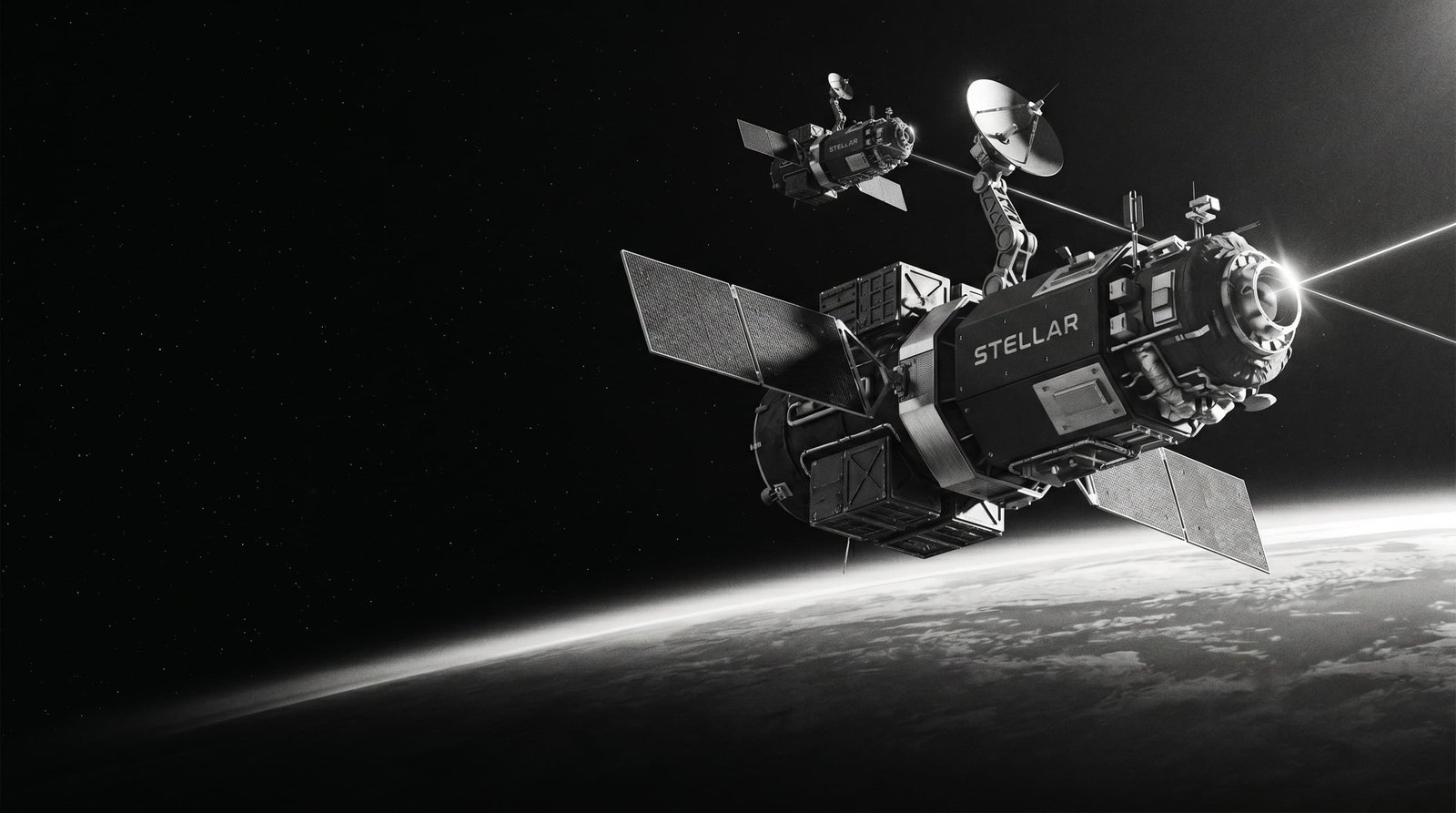
STELLAR Mesh constellation spacecraft
From mission nodes to orbital cloud network.

Optical relay. Autonomous operations. Distributed compute and storage fabrics. The orbital data infrastructure layer, complete.

01 / mission narrative

Why this mission, and what it must prove

Operate a space-native infrastructure layer that behaves like a distributed cloud region spanning orbital assets and terrestrial cloud endpoints.

01 / The category goal

A real cloud region in low Earth orbit

Node-5 is the architecture STELLAR has been building toward. A constellation of coordinated data-center nodes connected by optical inter-satellite links, scheduled and replicated automatically, integrated with terrestrial cloud regions through documented APIs. Customers route jobs to "STELLAR / orbital region" the same way they route to a hyperscaler region today.

02 / Why optical, why autonomy

Optical because RF runs out; autonomy because contact runs out

A mesh of compute and storage assets needs a backbone that scales with throughput, not bandwidth caps. Optical inter-satellite links replace the RF ISL used in Node-3 order-of-magnitude more capacity, lower latency, fewer regulatory constraints. Autonomy fills the gaps where ground contact is brief: nodes negotiate replication, failover, and customer policy among themselves between passes.

03 / Earth integration

Cloud handoff stops being an export it becomes a region

STELLAR Mesh exposes the orbital fabric to terrestrial customers as a documented cloud region: tasking, IAM, network policy, observability, billing. Workloads cross the boundary because the boundary is a routing decision, not a launch campaign. Earth and orbit become one delivery surface.

02 / mission profile

Orbit, payload, power, thermal, comms, partners

The profile is the mission’s physical truth every architectural choice descends from these numbers.

Orbit
Multi-plane LEO mesh phased + inclined
Altitude
500–650 km
Inclination
Multiple inclinations for global coverage
Operational duration
Continuous service refreshed by scheduled replacements
Payload class
Mesh-class nodes 250–400 kg per node
Power envelope
2.5–4 kW peak per node
Thermal envelope
2.5–4 kW peak heat rejection per node
Contact window
Continuous via optical ISL + global ground network
Primary partners
Multiple spacecraft prime contracts · Optical inter-satellite link supplier · Global ground-station network · Hyperscaler cloud integration partners · Long-tail commercial + sovereign customers
03 / technical architecture

Systems that must work as one

The mission is the sum of these subsystems and the way they constrain each other.

SystemSpecificationDesign note
Optical inter-satellite link~10 Gbps class optical ISL between nodesReplaces the Node-3 RF ISL. Carries replication, autonomy state, customer traffic. Multiple links per node form the mesh fabric.
Mesh schedulerAutonomous workload + replication routingEach node negotiates job placement and replication policy with peers between ground contacts. Customer policy (locality, residency, durability) is honored without ground in the loop.
Distributed compute fabricHeterogeneous compute lanes across meshDifferent node generations (Node-2/3/4 lineage) serve different workload classes. Customer jobs route to lanes that match SLA, locality, and policy.
Orbital storage fabricGeo-aware replication, routing, policy controlsStorage is addressable across the mesh. Customers specify residency, durability, and replication factor; the fabric places objects accordingly.
Cloud handoffDocumented region API + IAM + observabilitySTELLAR exposes the mesh to Earth-side cloud customers as a region same primitives as a terrestrial cloud region, with the orbital fabric on the other side.
Refresh / sustainmentScheduled mesh-member replacement campaignsNodes have finite operational lives. Sustainment campaigns add new nodes and retire old ones without service interruption.
04 / capabilities added

What this mission adds to the roadmap

Each mission is justified by a specific new capability not just a larger payload.

Capability 01

Distributed compute fabric for space-native and Earth-facing workloads

Capability 02

Orbital storage fabric with routing, replication, and customer policy controls

Capability 03

Optical relay and autonomous operations across the network

Capability 04

Ground-cloud interoperability for enterprise-grade service delivery

Capability 05

Continuous, latency-aware customer routing across the mesh

Capability 06

Programmatic onboarding for new mission and cloud customers

05 / phased plan

Mission timeline milestones, not vibes

The plan is broken into reviewable phases. Each phase ends in a deliverable a stakeholder can read.

Phase 0Concurrent with Node-4 ops
Mesh architecture freeze

Optical ISL contract, autonomy protocols, region-handoff API, and sustainment plan locked.

Phase 1TBD
First optical mesh 4 nodes

First four-node optical mesh demonstrates ISL, autonomy, and Earth-region handoff in operational service.

Phase 2Continuous
Mesh expansion

Scheduled launches expand mesh coverage and capacity. Sustainment campaigns retire and refresh nodes.

Phase 3Steady-state
Continuous service

STELLAR / orbital region operates as a documented cloud region with continuous customer service and scheduled refresh.

06 / risk register

What is closed, mitigated, in design, or open

A serious mission tracks risks honestly. Closed, mitigated, in design, and open items are listed without softening.

RiskStateDescription
Optical ISL acquisition + maintenanceIn designOptical ISL is the highest-risk Node-5 subsystem. Vendor selection, pointing/tracking budget, and acquisition rituals are mission-defining.
Autonomy correctness at scaleIn designMesh autonomy must be correct under partial failures, partial connectivity, and customer-policy conflicts. Validated against GroundLab mesh-twin and prior-mission telemetry.
Sustainment + retirement cadenceOpenA real region requires planned replacement. Sustainment cadence is built into the mesh operating model rather than improvised.
Hyperscaler integration scopeOpenCloud-region handoff is partner-specific. Scope and contract negotiated as Node-5 nears operational state.
07 / verification

Every claim ties to an evidence product

The right way to read a mission page: claim → evidence → state. If a row is in the wrong state, the page is what is broken not the program.

ClaimEvidenceState
Optical ISL meets contracted throughput across pointing envelope.On-orbit ISL link telemetry + acquisition statisticsPlanned
Mesh autonomy honors customer policy without ground intervention.Replay of customer-policy enforcement across pass-gap windowsPlanned
Region API parity with documented terrestrial-cloud primitives.Independent cloud-region certification suitePlanned
Sustainment cadence sustains contracted service availability.Sustainment plan execution + availability telemetryPlanned
From mission nodes to orbital cloud network.
Advancement
Node-5
Stage
Target architecture
Program state
09 / continuity

What this mission inherits, what it enables

Each mission is a step on a single staircase. These bridges spell out what comes from the prior step and what becomes possible after.

Roadmap / index

All STELLAR missions

Open roadmap

Continue into the technology architecture

Node-5 builds on Node-4 by moving from "From clustered infrastructure to secure service region." toward "From mission nodes to orbital cloud network.".