STELLAROrbital computing
Node-0 / Active software-first / 2026

GroundLab: executable digital twin and software mission rehearsal

GroundLab validates the software, thermal, workload, storage, comms, security, and operations models before flight hardware is committed. It is the program’s permanent executable twin and mission rehearsal environment.
Software twin
Environment
Control loop
Risk retired
Flight candidate
Output
Node-0/ visual
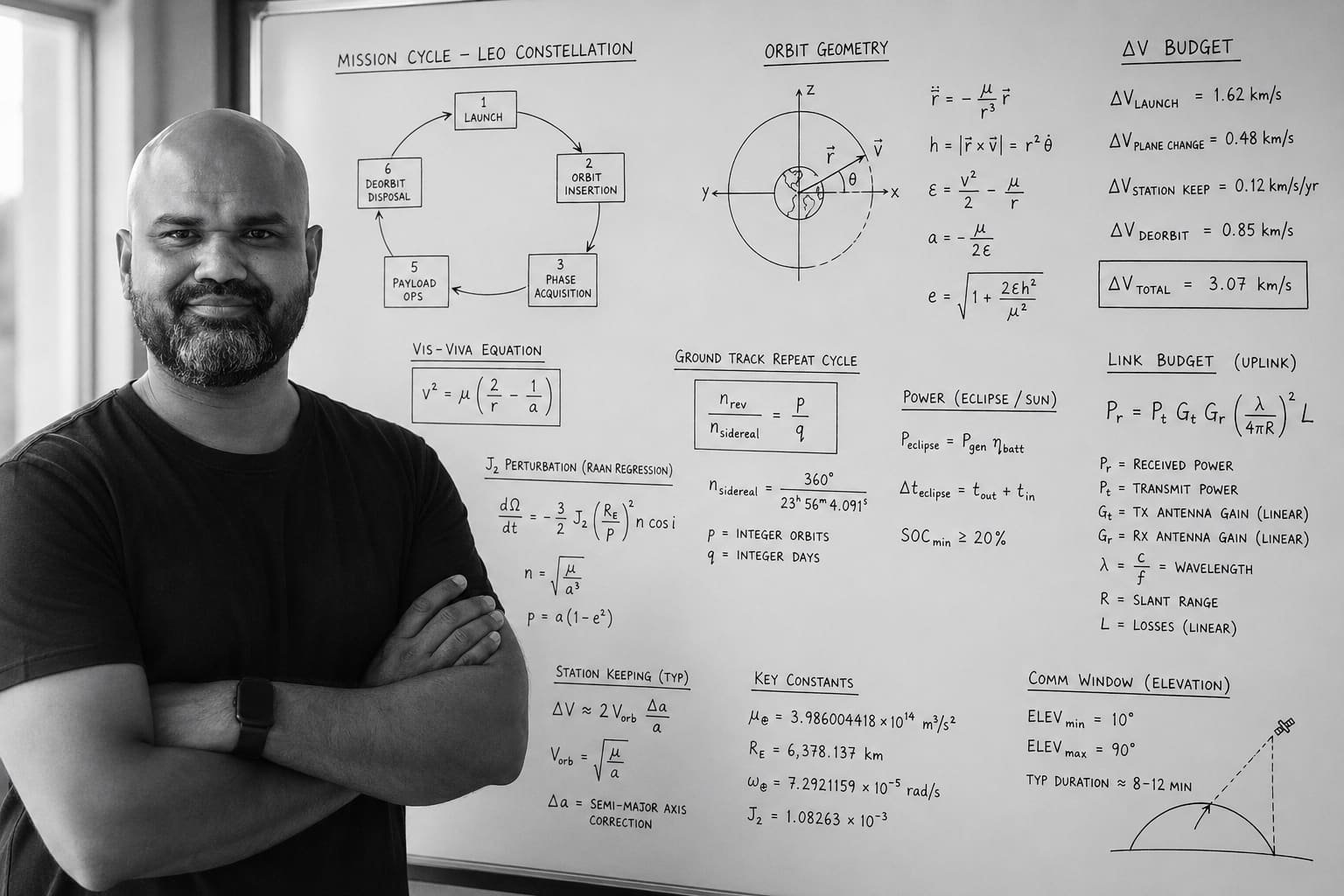
Engineer at a whiteboard mapping orbital mission cycles
From concept architecture to repeatable software mission proof.

Every orbital data center starts in software. GroundLab is where the operating model, control loop, and customer workflow are proven in code before funded flight hardware.

01 / mission narrative

Why this mission, and what it must prove

Build the mission simulator, software-in-the-loop control path, hardware-interface emulator, thermal duty-cycle model, and customer workflow emulator that every later orbital node depends on.

01 / Why ground first

A spacecraft is the worst place to discover a software bug

Orbital data centers operate inside a strict envelope of power, thermal, contact, radiation, and propellant. A mistake in any of those domains compounds a dropped command becomes a missed pass, becomes a thermal excursion, becomes a safe-mode lockout. GroundLab exists to discover and retire those mistakes in executable software before any flight hardware is committed.

02 / What it is

A software-in-the-loop digital twin of every later node

GroundLab is a permanent mission rehearsal environment that mirrors the planned Node-1 payload behavior without claiming funded hardware access: compute lanes, storage queues, command authority, thermal limits, contact windows, eclipse cycles, radiation-like resets, and operator commands are all emulated through strict interfaces. Every payload software build runs against this twin before it can become a flight-candidate baseline.

03 / What it produces

A flight-candidate operating baseline

GroundLab’s output is not a paper it is a frozen, testable software baseline plus a working operations model: tasking workflow, command authorization rules, pass scheduling, fault response, downlink reconciliation, and customer delivery evidence. Hardware qualification and flight heritage remain later gates, but the software proof can be real now.

02 / mission profile

Orbit, payload, power, thermal, comms, partners

The profile is the mission’s physical truth every architectural choice descends from these numbers.

Orbit
N/A ground integration laboratory
Altitude
Sea level
Inclination
N/A
Operational duration
Permanent used by every subsequent mission
Payload class
Software mission rehearsal + hardware-interface emulator
Power envelope
Modeled EPS envelope with eclipse and battery constraints
Thermal envelope
Modeled hot/cold cases with duty-cycle throttling
Contact window
Synthetic pass schedule plus continuous development mode
Primary partners
Mission-simulator software partner · Future compute fabric vendor (FPGA / management CPU) · Future hosted-payload / spacecraft-bus partner · Software & test infrastructure (SIL and interface-emulation bench)
03 / technical architecture

Systems that must work as one

The mission is the sum of these subsystems and the way they constrain each other.

SystemSpecificationDesign note
Mission simulatorReal-time orbit + contact + eclipse modelGenerates realistic mission state pass timing, link availability, sun vector, eclipse, battery state-of-charge, radiation events and injects it into the payload software stack at the same cadence the bus would.
Compute payload emulatorFPGA-lane + management-CPU behavior modelSoftware model of the planned compute path: workload lanes, watchdog behavior, reset recovery, checkpointing, and resource limits. Real board selection and qualification remain future funding and partner gates.
Storage and receipt emulatorIntegrity-checked queue + replayable product ledgerPersistent product queue with hash-chain integrity, priority ranking, and replayable delivery receipts. Tested against contact-gap, storage-pressure, and simulated corruption scenarios.
Thermal modelCoupled compute load → heat path → radiator sizingClosed-loop simulation: a compute burst raises waste heat, which is rejected through cold-plate / loop-heat-pipe / radiator paths and capped by orbital hot/cold case envelopes. Drives duty-cycle policy.
Operations consoleTasking, scheduling, command authorization, deliveryThe same UI and command path that mission ops will use in flight. Every action is logged and reconciled against the simulator’s expected behavior.
Customer-API prototypeJob submission, policy, receipt, callbackA documented HTTP API + customer SDK that submits jobs into the queue, returns receipts, and reconciles delivery. Used to onboard early design partners against the simulator.
04 / capabilities added

What this mission adds to the roadmap

Each mission is justified by a specific new capability not just a larger payload.

Capability 01

Node digital twin for orbit, power, thermal, and contact windows

Capability 02

Software-in-the-loop workload execution and restart tests

Capability 03

Hardware-interface emulation for bus, comms, storage, and command boundaries

Capability 04

Mission operations rehearsal for tasking, downlink, and delivery

Capability 05

Ground-cloud API prototype for early customer workflow testing

Capability 06

Flight-candidate software baseline used by every later mission gate

Capability 07

Repeatable thermal duty-cycle simulation tied to compute load

05 / phased plan

Mission timeline milestones, not vibes

The plan is broken into reviewable phases. Each phase ends in a deliverable a stakeholder can read.

Phase 0H1 2026
Software mission lab buildout

Stand up mission simulator, interface emulators, digital-twin assumptions registry, operations console, and customer API contract.

Phase 1H2 2026
First closed-loop sim

Run a synthetic 30-day orbital cycle end-to-end: tasking → execution → storage → downlink → delivery receipt.

Phase 2H2 2026
Design-partner onboarding

Two design partners run real workloads against the customer API. Feedback drives the Node-1 service contract.

Phase 3Pre Node-1 CDR
Flight-candidate software baseline frozen

Software, operations procedures, interface contracts, and customer API are version-locked. Hardware qualification remains a separate funded gate.

06 / risk register

What is closed, mitigated, in design, or open

A serious mission tracks risks honestly. Closed, mitigated, in design, and open items are listed without softening.

RiskStateDescription
Simulator fidelity vs. real orbital stateIn designThe simulator must remain measurably faithful to expected orbital behavior drift introduced by Node-1 telemetry is the calibration loop.
Software baseline driftMitigatedEvery Node-1+ software build branches from the frozen GroundLab baseline. Regression and mission-rehearsal suites gate every cherry-pick.
Customer-workflow assumptionsOpenAPI ergonomics, policy model, delivery format are validated only through design-partner usage. Closed when first paying customer signs.
Thermal model conservatismIn designThermal margins driven by model assumptions will be re-baselined against later lab, partner, and flight telemetry as funding unlocks hardware access.
07 / verification

Every claim ties to an evidence product

The right way to read a mission page: claim → evidence → state. If a row is in the wrong state, the page is what is broken not the program.

ClaimEvidenceState
The flight software model recovers from simulated compute-lane reset without losing mission state.SIL fault-injection campaign with deterministic reset/restart evidenceClosed
Priority products remain deliverable across modeled AOS, marginal-link, and LOS windows.Executable degraded-link campaign with queue integrity and delivery receipt evidenceClosed
Safe-hold freezes nonessential work while preserving customer data.Executable safe-hold recovery campaign with checkpoint preservation and operator recovery pathClosed
Modeled mission behavior stays inside release-gate limits across bounded variance.Seeded Monte Carlo mission-assurance campaign with explicit hardware limitationsClosed
Storage queue survives 24-hour contact gap without product loss.Simulated 48-orbit no-contact scenarioDraft
Customer job → execution → delivery receipt loop closes in under 90 minutes.Design-partner end-to-end run, ground-cloud telemetryPlanned
Thermal duty-cycle policy keeps simulated payload inside modeled hot-case margin.Model assumptions, sensitivity report, and thermal-duty scenario outputsDraft
From concept architecture to repeatable software mission proof.
Advancement
Node-0
Stage
Active software-first
Program state
09 / continuity

What this mission inherits, what it enables

Each mission is a step on a single staircase. These bridges spell out what comes from the prior step and what becomes possible after.

Roadmap / index

All STELLAR missions

Open roadmap

Continue to Node-1: Pathfinder Payload

GroundLab begins the risk-retirement path that every flight mission depends on.