
STELLAROrbital computing
Node-1 / Design baseline / Mission 1

Node-1: Pathfinder orbital data-center payload

Node-1 validates the foundation: spacecraft interfaces, compute payload operation, resilient storage, thermal duty cycles, downlink delivery, and mission operations.
Hosted
Payload class
ICD + Ops
Primary proof
Demo jobs
Customer mode
Node-1/ visual
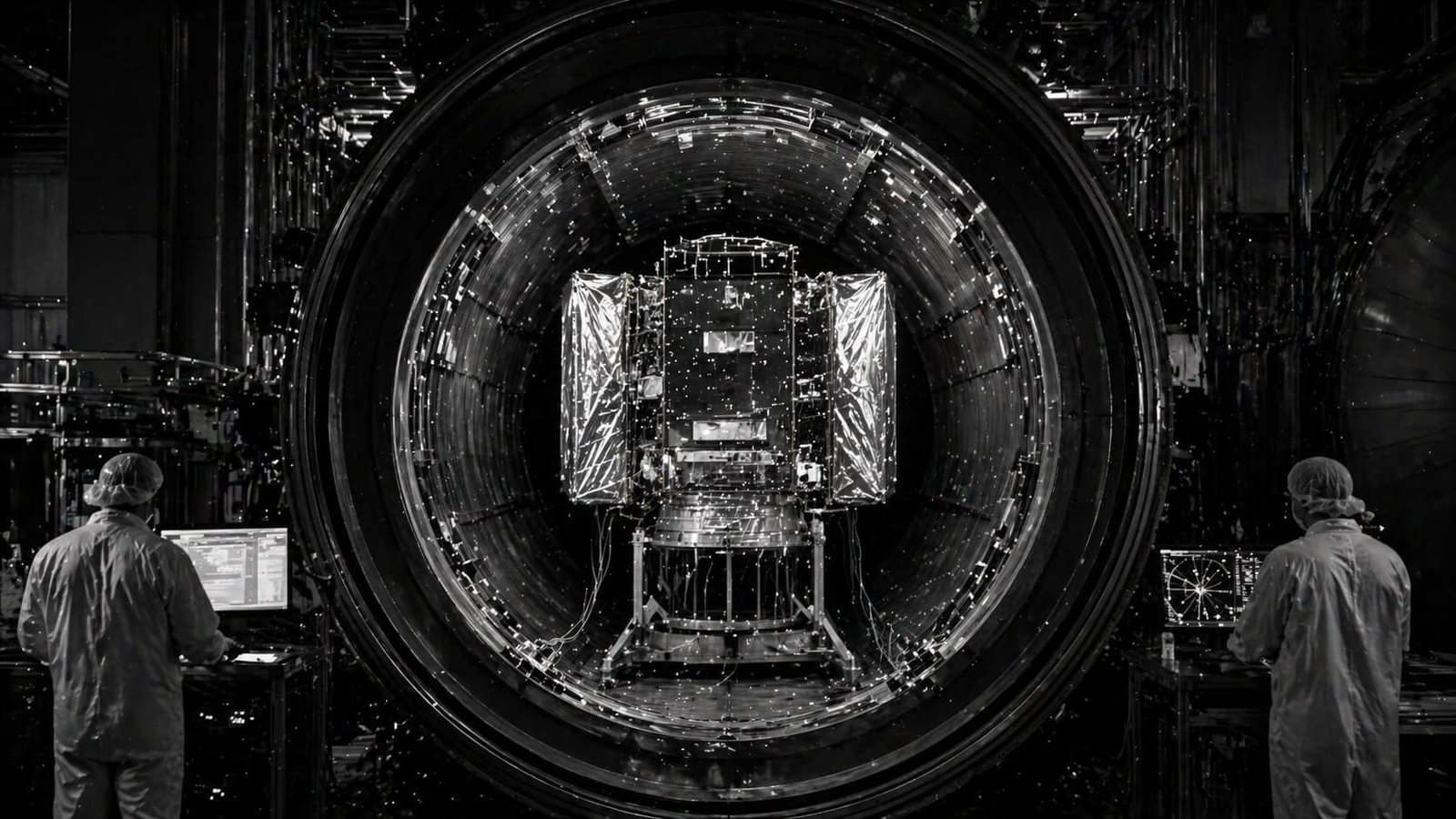
Pathfinder payload integration in clean room
From ground simulation to hosted orbital payload.

The first STELLAR payload in space. Hosted on a partner spacecraft. Designed to prove that compute and storage can be operated as a mission service inside real orbital limits.

01 / mission narrative

Why this mission, and what it must prove

Fly a hosted payload that proves STELLAR can operate compute and storage as a mission service inside real spacecraft limits.

01 / The first orbital proof

Not a satellite. A payload service.

STELLAR’s thesis is that orbital compute is infrastructure, not a satellite mission. Node-1 makes that claim concrete: a self-contained data-center payload integrated as a hosted module on a partner spacecraft, sharing power, thermal interfaces, attitude, and downlink while behaving as an independent service for STELLAR’s customers.

02 / What it must prove

Three things, end-to-end, for the first time

First, that the payload software stack survives real orbital conditions radiation, resets, contact gaps, thermal cycles. Second, that the operations model tasking, scheduling, delivery, evidence works without an engineer intervening in the loop. Third, that an external customer can submit a job and receive a verifiable result through the Node-1 service contract.

03 / Constraints that shape the design

95 kg, 838 W, 42–55 minutes of contact a day

Node-1 fits inside a 95 kg hosted-payload allocation in a 500 km sun-synchronous orbit at 97.4° inclination. Peak compute thermal load is 838 W; radiator hot-case capacity caps duty cycle. X-band downlink delivers 100–500 Mbps over a 42–55 minute daily contact window. Every architectural choice is downstream of those numbers.

02 / mission profile

Orbit, payload, power, thermal, comms, partners

The profile is the mission’s physical truth every architectural choice descends from these numbers.

Orbit
500 km sun-synchronous orbit (10:30 LTAN)
Altitude
500 km
Inclination
97.4°
Operational duration
12-month nominal operational window
Payload class
Hosted payload 95 kg allocation
Power envelope
950 W peak / 480 W average from host bus
Thermal envelope
838 W peak heat rejection / 1,200 W radiator capacity
Contact window
42–55 min/day X-band, 100–500 Mbps class
Primary partners
Spacecraft host bus partner (TBD) · Launch services partner · Compute fabric vendor (FPGA / GR740) · Ground station network · Two design-partner customers
03 / technical architecture

Systems that must work as one

The mission is the sum of these subsystems and the way they constrain each other.

SystemSpecificationDesign note
Compute fabricXQRVC1902 FPGA inference fabric, ~26 TOPSRadiation-tolerant FPGA chosen for predictable behavior under SEU events. Workload-isolated execution lanes; ECC; checkpointable restart.
Management CPUGR740 quad-core LEON4 SPARCWatchdog, command authorization, FDIR (failure detection / isolation / recovery), payload state machine, telemetry mux.
Storage pathECC DDR4 + 2 TB RAID-1 SSD + 128 GB priority queueMission products land in the priority queue, hash-chained for integrity, and are persisted on RAID-1 for continuity through pass gaps.
ThermalCold plates → loop heat pipe → deployable radiatorsCompute waste heat is collected at the cold-plate interfaces, transported by LHP to two deployable radiator panels sized for hot-case heat rejection plus margin.
CommsX-band downlink, S-band TT&CMission data downlink at 100–500 Mbps class over X-band; redundant S-band telemetry, tracking and command path through host bus.
Software & opsGroundLab-validated flight-candidate software baselineSame software control loop rehearsed in the GroundLab digital twin. Operations console, tasking workflow, and customer API contract are inherited with explicit hardware-qualification limits.
04 / capabilities added

What this mission adds to the roadmap

Each mission is justified by a specific new capability not just a larger payload.

Capability 01

Hosted payload interface with spacecraft bus services

Capability 02

Radiation-aware compute path with checkpoint and restart behavior

Capability 03

Resilient storage queue with integrity checks and delivery receipts

Capability 04

Thermal duty-cycle management tied to orbit, power, and radiator capacity

Capability 05

Operator-authorized tasking and scheduling from ground

Capability 06

End-to-end customer demo workload submit, execute, deliver

05 / phased plan

Mission timeline milestones, not vibes

The plan is broken into reviewable phases. Each phase ends in a deliverable a stakeholder can read.

Phase 0Q3 2026
Mission baseline + ICD draft

Lock orbit, mass/power/thermal allocation, host-bus interface document, and customer API contract.

Phase 1Q1 2027
Preliminary Design Review (PDR)

System architecture, ICDs, and verification plan reviewed against mission baseline.

Phase 2Q3 2027
Critical Design Review (CDR)

Detailed design closure: FPGA build, thermal correlation, software flight baseline, ops procedures.

Phase 3H1 2028
Integration & TVAC qualification

Funded EQM in thermal-vacuum chamber; flight unit assembly; payload-to-bus integration.

Phase 42028
Launch + commissioning

Launch + L+24h power-on, L+48h initial downlink, 30-day commissioning campaign.

Phase 52028–2029
Operational service

Twelve-month nominal window: customer demo workloads, telemetry calibration, GroundLab feedback loop.

06 / risk register

What is closed, mitigated, in design, or open

A serious mission tracks risks honestly. Closed, mitigated, in design, and open items are listed without softening.

RiskStateDescription
Host-bus interface alignmentIn designPower, mechanical, thermal, data, and command interfaces with the partner spacecraft are tracked as the dominant pre-PDR risk.
X-band link budget reconvergenceOpenCurrent draft link budget uses 600 km nominal range; closed orbit ADR sets 500 km SSO. Reconvergence in progress before PDR.
Single-event upset (SEU) recoveryMitigatedGR740 watchdog + FPGA partial-reconfiguration recovery + checkpointed workload restart. Validated first through SIL and interface-emulation fault injection; hardware validation remains a later gate.
Thermal hot-case marginMitigatedCurrent sizing carries ~43% margin against hot case. Final correlation against TVAC test moves this to Closed.
Customer delivery SLA on first flightOpenNo formal SLA on Node-1; design-partner workloads run in best-effort demo mode. SLAs are introduced on Node-2.
Funded flight hardware boundaryOpenNode-1 is currently a software-first pathfinder baseline. Physical EM/QM/FM hardware, environmental qualification, launch-provider acceptance, and flight heritage remain future funding and partner gates.
07 / verification

Every claim ties to an evidence product

The right way to read a mission page: claim → evidence → state. If a row is in the wrong state, the page is what is broken not the program.

ClaimEvidenceState
Payload survives ascent + commissioning + 30-day shakedown.Vibration + thermal-vacuum + commissioning reportPlanned
Compute path completes a customer demo workload in orbit.Customer-receipt + ground-cloud reconciliation logPlanned
Storage queue delivers products through three consecutive pass gaps.Telemetry + receipt chain over 7-day campaignPlanned
Thermal duty cycle stays within hot-case margin under peak compute.On-orbit thermal telemetry vs. SINDA predictionDraft
X-band downlink hits class throughput envelope.RF link-budget reconverged to 500 km SSO + on-orbit measurementOpen
From ground simulation to hosted orbital payload.
Advancement
Node-1
Stage
Design baseline
Program state
09 / continuity

What this mission inherits, what it enables

Each mission is a step on a single staircase. These bridges spell out what comes from the prior step and what becomes possible after.

Roadmap / index

All STELLAR missions

Open roadmap

Continue to Node-2: Edge Compute Node

Node-1 builds on Node-0 by moving from "From concept architecture to repeatable software mission proof." toward "From ground simulation to hosted orbital payload.".